
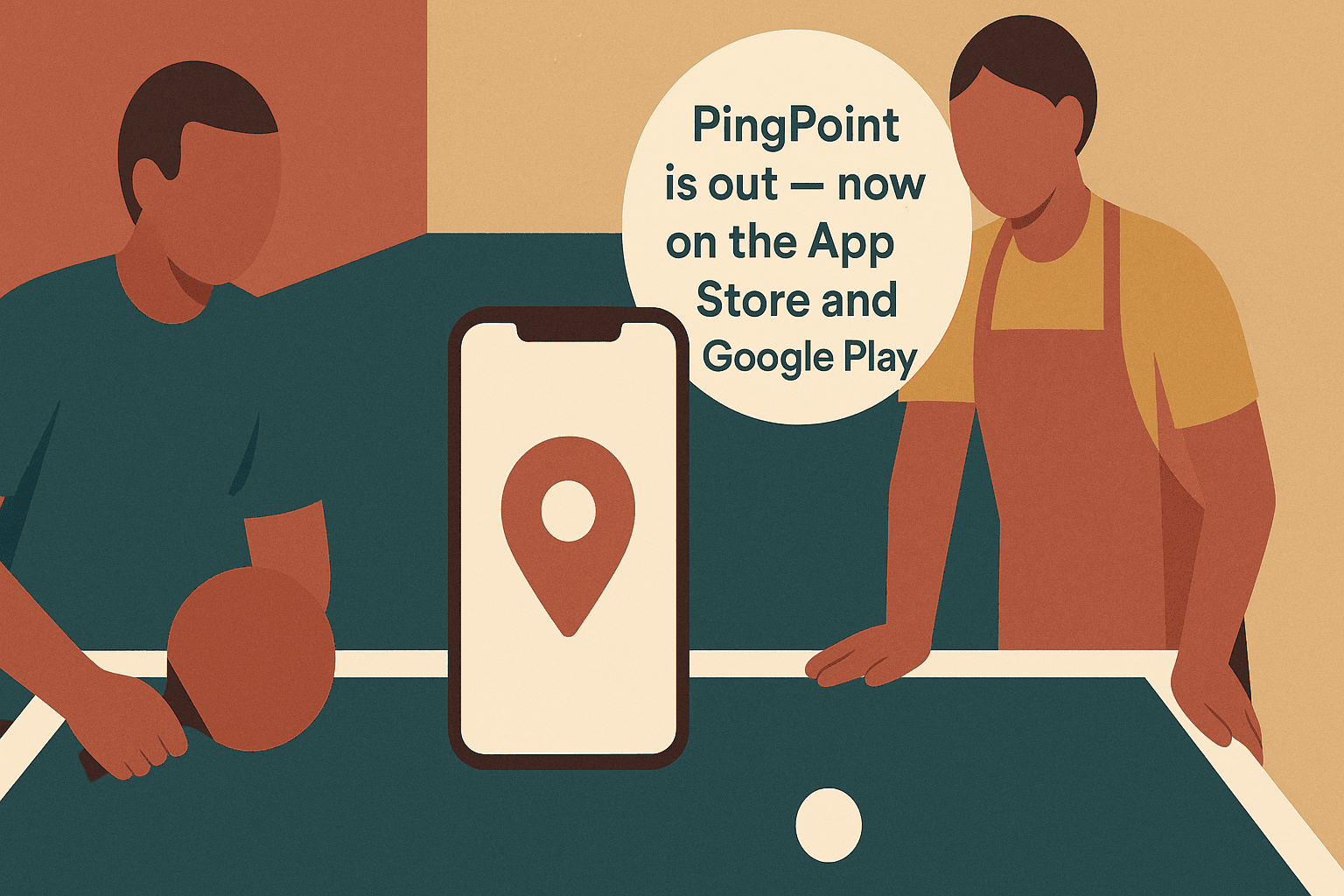
PingPoint is out — now on the App Store and Google Play
After a year of work the app has been approved and is on both stores. The shop is open too.
1 min read
6 Oct, 2026

Doubles table tennis is fast, fun, and a little confusing at first. The scoring is the same as singles, but serving has one extra layer: the serve must go diagonally, and all four players rotate through a fixed order.
Once you understand the pattern, doubles serving becomes much easier. This guide explains the rules in plain English so you can start a match without arguing about who serves next.
In doubles, every serve is diagonal. The server stands on the right side of their end of the table and serves to the right side of the opponent's end. If the serve lands on the wrong half, it is a fault.
This is the biggest difference from singles. In singles, you can serve anywhere on the table. In doubles, the serve always travels from right half to right half.
At the start of a game, one player serves for two points. After those two points, the serve moves to the other team. The player who received now becomes the server, and the next receiver is the partner of the previous server.
The order moves around all four players:
| Turn | Server | Receiver |
|---|---|---|
| 1 | Player A | Player C |
| 2 | Player C | Player B |
| 3 | Player B | Player D |
| 4 | Player D | Player A |
Each player serves for two points, then the pattern repeats.
During a doubles rally, partners must alternate shots. If you hit the ball, your partner must hit the next ball for your team. You cannot hit twice in a row.
This is why doubles positioning matters so much. After serving or returning, players usually move quickly to give their partner space for the next shot.
When the score reaches 10-10, the game is at deuce. From that point on, each player serves only one point before service changes. The same serving order continues, just faster.
The game still continues until one team leads by two points. Scores like 12-10, 15-13, or 21-19 can all happen.
At the start of each game, the team that serves first can choose which partner starts serving. In the first game, the receiving team chooses who receives that first serve.
After the first game, the receiving order is no longer a free choice. Once the first server is chosen, the first receiver is fixed by the previous game: it should be the player who served to that server in the game before.
In the final deciding game, teams switch sides when one team reaches 5 points. In doubles, the receiving pair then changes its receiving order, so the same server serves to the other receiver after the change of ends.
Think of doubles serving as a circle. Serve for two points, then pass the serve to the player who just received. Keep moving around the four players in order. Between games, remember that the serving team may choose the first server, but the receiver may already be determined by the previous game's order.
If everyone remembers the diagonal serve and the rotation pattern, doubles becomes much smoother. You can stop worrying about the rules and start focusing on the real challenge: placing the ball well enough that your partner gets the next attack.
After a year of work the app has been approved and is on both stores. The shop is open too.

Apple and Google have approved PingPoint for external testing. Anyone can install it now — here are the steps for iPhone, Apple Watch, Android and Wea...

Press once when you win a point, twice when your opponent does. How a Bluetooth button on your wrist keeps the score without taking you out of the gam...
After a year of work the app has been approved and is on both stores. The shop is open too.
After a year of work the app has been approved and is on both stores. The shop is open too.
Apple and Google have approved PingPoint for external testing. Anyone can install it now — here are the steps for iPhone, Apple Watch, Android and Wea...
Apple and Google have approved PingPoint for external testing. Anyone can install it now — here are the steps for iPhone, Apple Watch, Android and Wea...
Press once when you win a point, twice when your opponent does. How a Bluetooth button on your wrist keeps the score without taking you out of the gam...
Press once when you win a point, twice when your opponent does. How a Bluetooth button on your wrist keeps the score without taking you out of the gam...
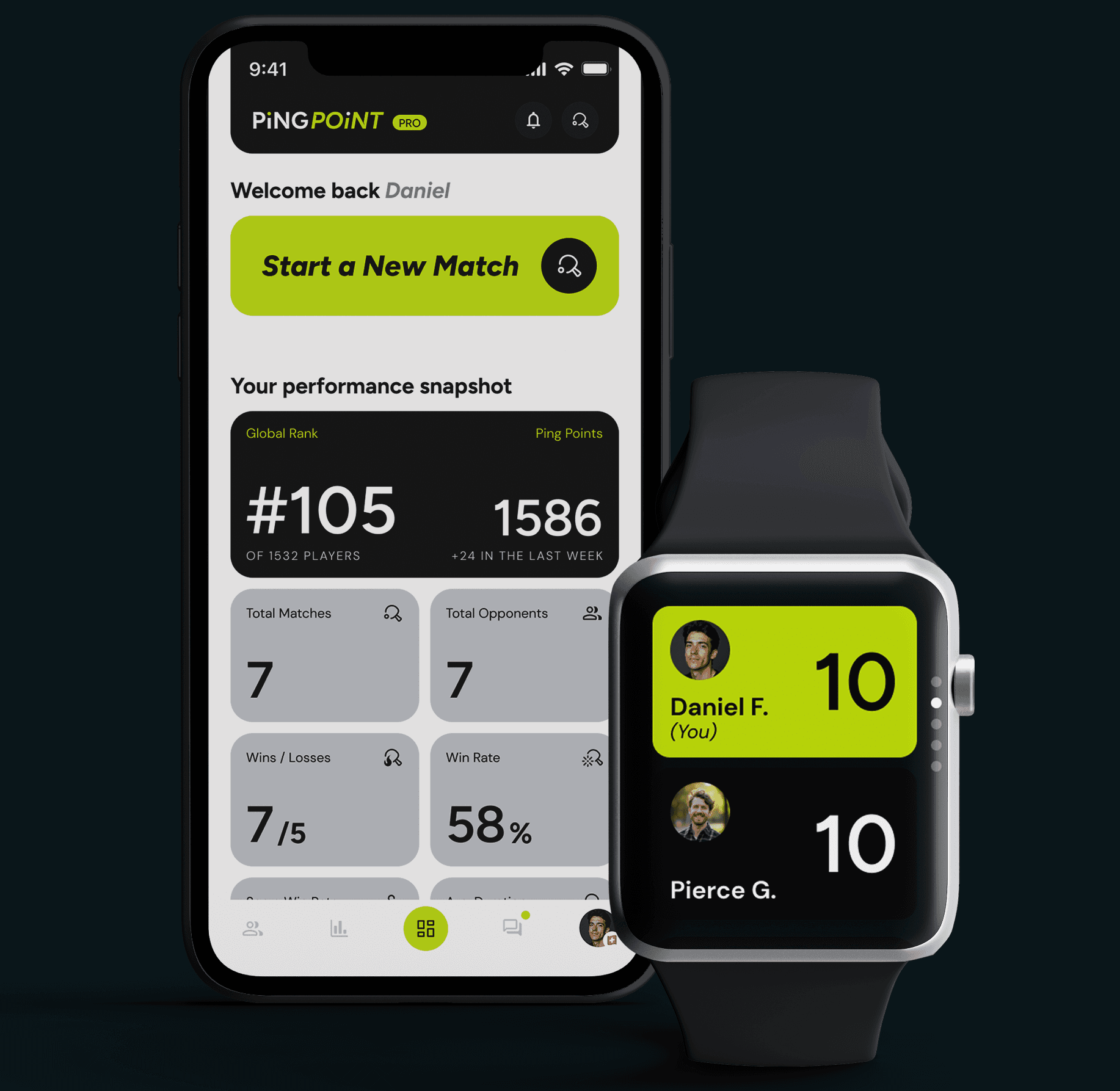
Download the app and take your game everywhere: on mobile, tablet, or smartwatch.

